BeatMind
Drop in a song and get back five stems, with every section and chord mapped, in an editor you can work in.
What it is
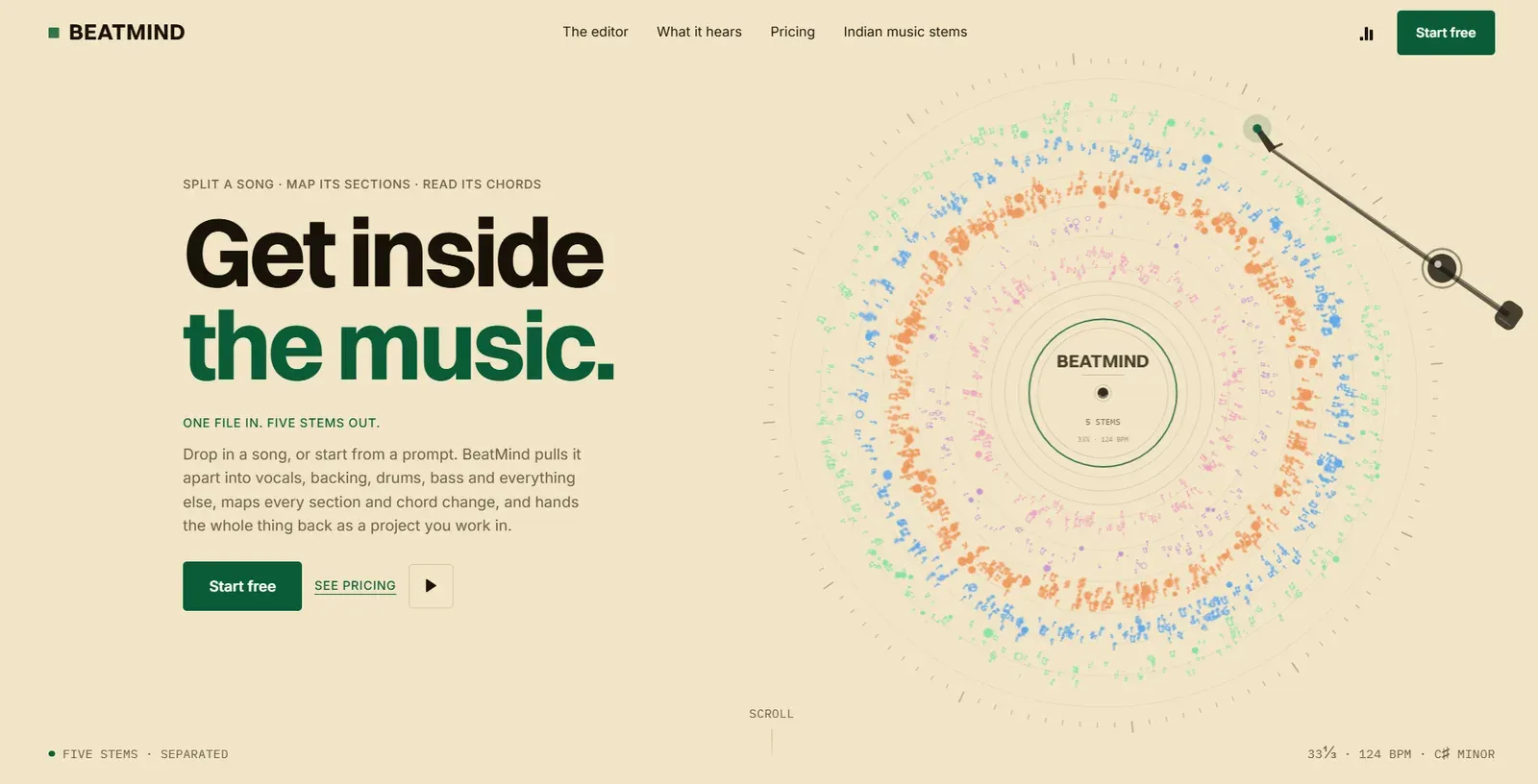
BeatMind takes a song apart and lets you rebuild it. Upload a track and it separates five stems, reads the tempo and key, maps every section and chord, and hands it back as a project you work on in an editor. Or describe a song and it writes one, which you edit the same way.
Parth designed the interface, built the product and the pipeline behind it, and took it live, working alone.
What broke
Separating a four-minute track took 70 seconds. The obvious answer was a bigger GPU.
What we found
The GPU was not the problem. A missing library had quietly pushed the work onto the CPU while the GPU sat idle. A dependency had drifted underneath a pinned version, and nothing reported an error.
We measured the generation service the same way. Diffusion, the part a bigger GPU speeds up, took 0.42 s of a 16.32 s run. An L40S was both the cheapest and the fastest of the three GPUs we tried, so we did not upgrade. The cost that mattered was the idle time after each run: six times the cost of the generation itself.
What it did
With the library fixed, separation takes 23.4 seconds. We re-ran the check on two kinds of GPU, because the whole bug was an assumption nobody had verified.
The hard part nobody sees
A four-stage GPU pipeline fails in ways you cannot see: a worker dies mid-render, a GPU gets reassigned, a retry races the original. Each job is a resumable state machine with timeouts and retries, and a fencing token so a worker that wakes up late can never overwrite a newer result.
One day production served every page correctly and the product did not work. A redirect between two versions of the domain made the GPU’s reply to the app disappear, and a second, separate setting blocked uploads. No error appeared anywhere. We found both by using the live product the way a customer would.
Rights, not a checkbox
Export is blocked unless a track’s origin can be traced. We first built a checkbox where people confirm they own the rights, then deleted it, because a checkbox is not a rights check. Now even a fully generated track has to pass a fingerprint check against a database of known songs before it can leave.
Who used it
In the first days after it went public, 122 people signed up. At least 93 finished a track and rated it 4.5 out of 5. That score is self-reported by people who chose to answer. Figures as of 31 August 2026.
What we have not measured
That was one burst of attention, not a standing rate. There is no retention data yet, so we make no claim about daily use. BeatMind is built for about a hundred users a day.
How it is built
Next.js, React, TypeScript, Postgres on Neon, Clerk for sign-in, Cloudflare R2 for files, and four Python services on GPUs.
Next build
Vivid. Write a scene and get a storyboard of cinematic pictures. We rebuilt the engine that makes them, and built the test that says whether any change makes them better or worse.
read the build: Vivid